Research: The Nvidia Coup
Twenty-six days, October 29 to November 23, 2026: the campaign that removed the one chief executive in American AI arguing for open-weight models and against chip and remote-access controls, the money and fellowships behind the coverage that called for his head, the board that took his resignation, and the White House that put him back. Every player on both sides, from their own pages and filings.
Contents
Companion to NVIDIA, The Financialization of Frontier AI and EA and AI Safety Funding. Profiles opened for this file: Tarbell Center for AI Journalism, Shakeel Hashim, The Midas Project, and the NVIDIA board: Harvey C. Jones, Stephen C. Neal, Tench Coxe, Mark A. Stevens, A. Brooke Seawell, Dawn Hudson, John O. Dabiri, Melissa B. Lora, Aarti Shah and Suzanne Nora Johnson.
The same record sorted by person, who drove the ouster, who stood to gain and why the President reversed it, is The Nvidia Coup: The Players, with new profiles of Scott Bessent, Howard Lutnick, Steve Bannon and Rene Haas.
The story as one piece: The Yoink of NVIDIA. The foreign states and capital in it, channel by channel: The Foreign Hands.
Sourcing standard: the actors’ own pages and filings first (NVIDIA’s 8-Ks and proxy statement, the Federal Register, Tarbell’s and Transformer’s own pages, the Midas Project’s own investigations), then the reporting, named by outlet and byline. The New York Times, Wall Street Journal, Bloomberg and Financial Times pieces that drove the story are linked where they are cited.
1. The reading
For twenty-six days the most valuable chip company on earth had no founder at its head. In that window the one chief executive in American AI who argued, in his own name and with his company’s money, for open-weight models and against chip and remote-access controls was removed, and the rule his company had lobbied against was written. Then the President of the United States dialled into the board meeting and put him back.
It was a coup, and the weapon was two words: “Chinese spy.” No agency of the United States would put its name to them. The Attorney General said there were “no conclusions” about who she was; officials close to the Director of National Intelligence called the label “over-torqued”; the CIA was “not yet convinced”; the Treasury Secretary called it “kind of a canard”; and on the morning of the reinstatement the President wrote that the government “does not possess evidence that he has engaged in any unlawful conduct” (section 3). The label was never proved, and it was never meant to be. It only had to hold long enough to move a board. It held for exactly as long as it took: the resignation on 11 November, the board’s refusal on 17 November, the rule on 19 November. Then it collapsed, and the board’s own release cited the government’s word that he posed “no national security risk.” A misinformation campaign does not need its central claim to be true. It needs the claim to be repeated by enough serious people for long enough to take a seat.
That is an attack on two things at once. On the United States, because a counter-intelligence file the government had held since the spring was turned, through anonymous briefings, into the lever that removed the head of the country’s most strategic company in the middle of a market rout, and because the government that held the file then overrode its own company’s board to undo the result. On open models, because the man removed was, in the words of the people who fought to bring him back, their protector.
The record for the second claim is in the participants’ own words:
- The White House’s reason for the reinstatement. “The pitch that resonated with Vance and Trump, who had been close to Huang, centered around the Nvidia CEO’s role as a protector of open-source models, and a check on the increasing power of closed frontier model makers like Anthropic and OpenAI, a person familiar with the matter told Semafor” (Semafor, Goswami and Talcott, 23 Nov 2026).
- The industry’s reading of the ouster. Replit’s chief executive Amjad Masad: “if Jensen, the premier champion of open models, is taken out then anyone who wants AI closed, centralized, and controlled might benefit” (The Verge, Emma Roth, 16 Nov 2026).
- The same reason, from a second outlet. “The two people said Trump and Vance wanted Huang reinstated because he’s a critical advocate for open-source models, which have become a flashpoint in artificial intelligence security debates. Unlike closed models, such as those from OpenAI and Anthropic, open-source models are generally cheaper and easier to customize” (Politico, Fedor and Gangitano, 23 Nov 2026 (mirror)).
- The analysts’ reading. SemiAnalysis, the day he left: “Maybe biggest of all: open source is under attack.” And: “Nvidia was single-handedly propping up the other American open source models with its efforts by investing in firms like Reflection, Thinking Machines, Poolside, and the Hugging Face acquisition” (SemiAnalysis, Patel et al., 12 Nov 2026).
- What NVIDIA had put its name to. The open-weights letter of 24 July 2026: “Open weight models–AI models that anyone can download, inspect, modify, and run on their own infrastructure–are an important part of that foundation” (NVIDIA, Open Weights and American AI Leadership (PDF)). Anthropic did not sign it: “Anthropic and xAI are still not among them” (NYU Shanghai RITS). Anthropic’s own line: “All sufficiently capable models, open and closed, should go through mandatory safety testing” (Anthropic, 27 Jul 2026).
2. The sequence
| Date | Event | Source |
|---|---|---|
| Aug 2025 | NVIDIA’s general counsel emails the Commerce agents on the Megaspeed case, invoking Under Secretary Jeff Kessler; the case passes to Justice | The New York Times, Swanson and Barrett, 9 Nov 2026 (mirror) |
| Oct 2025 | Trump briefed that Alice Huang “had a relationship with Mr. Huang and was presumed to be a spy”; no action taken | The New York Times, Swanson and Barrett, 9 Nov 2026 (mirror) |
| Spring 2026 | US intelligence intercepts communications showing a Megaspeed executive in an affair with a “masked” US person; officials request the name be unmasked; it is Jensen Huang. Secretary of State and National Security Adviser Marco Rubio drafts a memo to “a very small group of senior US officials” | CNN, Bertrand, Atwood, Lillis, Liptak, 13 Nov 2026 |
| May 2026 | Rubio briefs Trump aboard Air Force One en route to China; Huang joins the trip in Alaska | CNN, 12 Nov 2026 |
| 24 Jul 2026 | NVIDIA publishes the open-weights letter | NVIDIA (PDF) |
| 5 Oct 2026 | Tarbell Center announces a $10 million institutional grants programme; first grantees NPR’s Power and Influence team ($250,000) and Machine Gods, the Casey Newton and Kevin Roose show ($480,000) | Tarbell |
| 29 Oct 2026 | The New York Times reports Huang as the target of a Chinese spy plot; NVIDIA’s spokesman: “Jensen’s interactions with Ms. Huang are not unusual or unexpected”; Huang to Bloomberg: “it was all completely normal and not unusual” | as quoted by Transformer, Hashim, 9 Nov 2026 |
| 5 Nov 2026 | Situation Room meeting on the Megaspeed controls; Trump calls Musk; “Let’s get it done.” | Axios, 11 Nov 2026 (mirror) |
| 6 Nov 2026 | The Times reports the Rubio memo and the Ministry of State Security assessment | The New York Times, 6 Nov 2026 (mirror) |
| 8 Nov 2026 | Huang admits the affair; the board opens an inquiry and says it “has no reason to believe that either national security or NVIDIA secrets were compromised” | Transformer; The Guardian, Down and Milmo, 9 Nov 2026 |
| 9 Nov 2026 | Transformer: “Jensen Huang should resign” | Transformer |
| 10 Nov 2026 | The Midas Project publishes the sockpuppet network that defended Huang | Model Republic, Tyler Johnston |
| 11 Nov 2026 | The Times reports a second relationship, with an executive who reports to Huang | The New York Times, 11 Nov 2026 (mirror) |
| 11 Nov 2026 | Board accepts the resignation; Harvey C. Jones made chair | NVIDIA, Form 8-K |
| 16 Nov 2026 | “Stand with Jensen” letter passes 185,000 signatures | The Verge, Roth |
| 16 Nov 2026 | BIS says the remote-access rule was “written by and at the direction of the Department of Treasury and the National Security Council” | Politico, Messerly and Hawkins, 16 Nov 2026 |
| 17 Nov 2026 | On the earnings call the chair says the board does not intend to reinstate him; three directors keep pushing for his return | Semafor, Albergotti and Goswami |
| 19 Nov 2026 | Commerce publishes the remote-access rule as an interim final rule, effective the same day | Federal Register, 2026-23529 |
| 20 Nov 2026 | The Times reports that Huang used humiliation as a management tool for decades; his spokesman calls the allegations false | The New York Times, via Quartz; TechSpot |
| 21 Nov 2026 | The Attorney General tells Trump and Vance Huang is not “the target or the subject of any Justice Department investigation” | The Wall Street Journal, 23 Nov 2026 (mirror) |
| 22 Nov 2026 | Trump dials into the Sunday board meeting; the board votes unanimously to reinstate | Semafor, 23 Nov; NVIDIA, Form 8-K |
| 23 Nov 2026 | NVIDIA announces the reinstatement “following a series of discussions and meetings with Mr. Huang” and “input from senior levels of the United States government”; the stock rises 30 percent | NVIDIA Newsroom; CBS News, Watson |
| 23 Nov 2026 | Bipartisan fury in Congress; Sen. Tim Scott sets Huang’s public Banking hearing for 3 December | PBS News / AP |
| 23 Nov 2026 | Commerce adds Megaspeed and six other entities in Malaysia, Singapore and Thailand to the Entity List, effective the day of the reinstatement; published 25 November | Federal Register, 91 FR 76148, FR Doc. 2026-23999 (PDF) |
| 24 Nov 2026 | Huang apologises at an hour-long all-hands, says he broke the code of conduct and is in therapy; takes no questions | CNN, Gold |
| 24 Nov 2026 | Sen. Ruben Gallego on MSNBC: “you’re going to end up being poor and broke if you don’t cooperate” | Townhall |
| 24 Nov 2026 | Trump to the New York Post on a pardon: “It’s always an option, I guess, but I don’t think it’ll be necessary” | CNN, via Yahoo |
| 25 Nov 2026 | Promethean Action’s brief, “Why They Tried to Destroy Jensen Huang”: the defenders’ fullest case | Promethean Action; answered point by point in The Players, 8a |
| 1 and 3 Dec 2026 | Closed-door House interview; Senate Banking hearing, “Protecting America’s AI Advantage: Oversight of US Export Controls”, Huang the only witness | The Guardian, Campbell, 23 Nov 2026; Platformer, Newton, 24 Nov 2026 |
3. The “Chinese spy” label: the weapon, and who stood behind it
The file. “Alice Huang had been an important intelligence target for the National Security Agency for at least several months by the spring.” The unmasking: “upon seeing the raw intelligence, US officials requested that the American’s name be “unmasked”— revealing the individual to be the now- former NVIDIA CEO Jensen Huang” (CNN, 13 Nov 2026). The government held the file from the spring. It reached the public in late October, through anonymous briefings to reporters.
What the file proves, by the government’s own account. Attorney General Todd Blanche: “no conclusions reached by the Department of Justice, or by me, or by [FBI] Director Patel around who she is or is not.” “Some officials at the Office of the Director of National Intelligence, including those close to director Jay Clayton, have framed the characterization of Alice Huang as a Chinese spy as not entirely accurate and over-torqued, sources said.” A former Commerce official: “An intelligence operation wasn’t necessary to achieve that result” (CNN, 12 Nov 2026). On the morning of the reinstatement the President wrote that the Attorney General “has confirmed that the U.S. Government does not possess evidence that he has engaged in any unlawful conduct” (CBS News, 23 Nov 2026).
What the reporters who broke it wrote. The first report, 29 October: “When Mr. Trump was initially briefed on the intelligence last year, U.S. officials did not believe the Nvidia executive knew that Ms. Huang was gathering information for the Chinese.” “Mr. Huang has not received a defensive briefing, warnings sometimes given to Americans who are being targeted by foreign intelligence services, people briefed on the surveillance said.” And: “It is also not clear under what circumstances Ms. Huang began gathering information for Beijing, what information she passed along or its value to China” (The New York Times, 29 Oct 2026 (mirror)). The date of that first briefing: “Mr. Trump was briefed in October 2025 that Ms. Huang had a relationship with Mr. Huang and was presumed to be a spy, but the president chose not to do anything with that intelligence” (The New York Times, Swanson and Barrett, 9 Nov 2026 (mirror)). On 14 November: “For reasons that remain unknown, government officials didn’t tell Mr. Huang about the intelligence,” and, of the word the officials used among themselves, “the relationship was routinely described more pointedly as an affair” (The New York Times, 14 Nov 2026 (mirror)). Singapore, which had questioned her: “They concluded that there wasn’t enough evidence that she had committed a crime but barred her from returning to the country” (AP, 12 Nov 2026 (mirror)). China’s embassy called the reporting “unsubstantiated” and “nothing but smears against China”; the former CIA counter-intelligence analyst Peter Mattis, for the other side: “Jensen is someone you’d want to influence because he wields a lot of power and is at the crux of a world-shaping technology” (The New York Times, 6 Nov 2026 (mirror)).
The Treasury Secretary. Scott Bessent, on the compliance question: “We do need answers.” On the spy angle: “I think that is kind of a canard.” He had urged the board to look outside the company for a chief executive (CBS News, Hubbard, 22 Nov 2026). After the reinstatement: “Well, I said they should go to the outside, but he’s on the outside now” (CBS News, 23 Nov 2026).
The rule. The interim final rule published on 19 November establishes “new rules to prevent certain foreign actors from leveraging advanced computing power based on U.S. technology to threaten U.S. national security and foreign policy interests,” with restrictions on “overseas data centers that remotely supply significant volumes of compute to companies headquartered in Country Group D:5 or Macau” (Federal Register, 2026-23529; Federal Register record). The bill behind it, the Remote Access Security Act, “passed the House 369-22 on Jan. 12”; “We know that NVIDIA and Oracle have been lobbying against it, hard” (SemiAnalysis).
The memo, in the Times’s words. “Secretary of State Marco Rubio oversaw the drafting of” a memo “this past spring warning top Trump administration officials that Nvidia’s chief executive, Jensen Huang, was in a close relationship with a Chinese spy, multiple people briefed on the matter said” (The New York Times, 8 Nov 2026 (mirror)). It “cited intelligence that a Chinese businesswoman who had a close relationship with Nvidia’s chief executive was a spy for China’s Ministry of State Security, according to people briefed on the intelligence” (The New York Times, 6 Nov 2026 (mirror)). It “was circulated to only a handful of Cabinet officials,” and when Huang was invited aboard in Alaska, “Mr. Trump was not particularly moved by the information” (The New York Times, 14 Nov 2026 (mirror)). Trump, after the admission: “I think he’s an honorable guy. I think he probably has an excuse for it. You have to hear it” (The New York Times, 8 Nov 2026 (mirror)).
Whose words “spy” were. The Washington Post of 13 November, as Clash Report quotes it: Secretary of State and national security adviser Marco Rubio “reportedly used a CIA report to draft his own warning to President Donald Trump”; the memo recast the agency’s reporting “in his own more assertive terms”; “a leak of its findings set off a chain of events that culminated in the Nvidia chief executive’s resignation.” A former official, to the Post, on Huang’s opponents: “They wanted to destroy the influence Jensen had over the president.” The Post’s account rests on “a single anonymous source”; “At the G7 meetings in Paris this week, Rubio declined several times to answer questions about his role” (The Washington Post, 13 Nov 2026 (mirror); Clash Report, 14 Nov 2026). CNN’s sources put it the other way round: the memo “was not drafted specifically for President Donald Trump,” and “Multiple sources who read Rubio’s memo said that in this instance it was a prudent move” (CNN, 13 Nov 2026).
The room. On Thursday 5 November, a week after the first spy report, Rubio, Bessent, Hegseth and Greer met Lutnick in the Situation Room over the Megaspeed controls; then “Trump called tech advisor Elon Musk and agreed to move forward. Musk supported Rubio, Bessent, Greer and Hegseth’s case to impose the controls while Lutnick warned it “will start a trade war with China.”” Trump: “Let’s get it done.” Commerce “denied that Bessent confronted Lutnick” (Axios, Caputo, 11 Nov 2026 (mirror); Axios via Yahoo News). On 23 November the same Musk wrote of the reinstatement: “The mistake has been corrected” (The Verge, Lopatto, 23 Nov 2026).
The Commerce file. In August 2025 the agents working the Megaspeed case got an email from NVIDIA’s general counsel: “Tim Teter, Nvidia’s general counsel, said that Jeff Kessler, a top official at the department, had given Nvidia permission to reach out about the case.” Then: “The Justice Department requested that the Commerce Department pause its work on the investigation, and Commerce complied, one person familiar with the case said.” Commerce said it had acted “strictly by the book”; and “The department has not added a company to the entity list in over a year, the longest stretch without such a listing in 18 years” (The New York Times, Swanson and Barrett, 9 Nov 2026 (mirror)). In the Situation Room, Lutnick “muttered under his breath”: “I need to check with the president.” One official: “He’s stalling it out” (Axios, 11 Nov 2026 (mirror)). The rule that followed was, in the Bureau of Industry and Security’s own statement, “written by and at the direction of the Department of Treasury and the National Security Council”; Bessent on CNBC: “Commerce has the pen, and you will have to ask them about their internal processes”; Trump, of his two secretaries: “They have two different views,” “One wants to be friendly with China, and one wants to have a blowup with China.” Politico later changed the headline “to remove a reference to Commerce Department objections” (Politico, Messerly and Hawkins, 16 Nov 2026).
In circulation, not confirmed. On X, Kevin Bass (19 November) says a Trump official “illegally leaked to NYT a briefing on Rubio’s memo” and that “Rubio is now calling the leakers” criminals; a post quoting him (24 November) says Rubio “tried to take down Jensen in a coup and it failed,” over a group-chat screenshot (the post’s attached image) that calls itself “blind guess speculation from the outside”. No outlet reports a Rubio statement calling the leakers criminals, or names the leaker. A finance aggregator says Anthropic was “drawn into” the leak.
It is extraordinary.
Trump official illegally leaked to NYT a briefing on Rubio’s memo to Trump. Media frenzy follows. One of America’s great AI CEOs accused of sleeping with a spy, then removed in a board coup. For three weeks, Rubio said nothing about his own memo leak that led to this.
Rubio is aligned with Bessent on export restrictions, against Huang and Lutnick. There was a confrontation. Trump called Elon, who reportedly sided with Rubio and Bessent.
The spy narrative (from Rubio’s own memo!) collapses. Bessent (Rubio’s ally!) plays damage control. How? By face-hammering Jensen Huang on CNBC and Fox News by misrepresenting Nvidia’s financial documents, suggesting that intentional smuggling was clearly legible from public documents. (It was not.) Tinfoil conspiracy brainrot coming from the Treasury Secretary.
Yet Rubio is now calling the leakers “criminals”. Yes, they are by definition. But who was it? And who saw the memo? If the memo was to Trump, the circle who saw the memo might be very small. If so, that means Rubio is calling his close colleagues criminals. I don’t think Rubio leaked the memo, because if he did, the “criminal” accusation would be Exhibit A in legal proceedings.
But he won’t say who did leak it, because that would be publicly shooting a colleague.
The Democrats are closing in. There was some chip smuggling. But there was also genuine policy disagreement about the legitimacy of export restrictions in the first place. Trump went back and forth. I think he did the right thing. I think the chip export restrictions are mostly stupid.
Furthermore, how do you catch smuggling? Some of the documented chip smuggling operations are extraordinarily sophisticated and meticulous. How much should American chip makers know? How involved should they be in enforcement? A Commerce official has said during a hearing that they lack manpower for enforcement, too, so who is enforcement going to come from?
But none of this will matter when the Democrats come, and Trump officials know this. They know that the Democrats will LARP about national security, suddenly transforming themselves into respectable, ardent patriots overnight – just so that they can eviscerate and lawfare the hell out of every single Trump official they can. They will leave no stone unturned. No scandal will be too minor for them to blow into national headlines about the threat of China, which they don’t really care about. But they will pretend to, just so they can punish everyone they can get their hands on.
Meanwhile, the useful idiot Republicans in Congress will bray endlessly about China, too, and the Microsoft/Amazon/Anthropic lobbyists will feed them brainrot. I have been reading some of these Congressional reports, and it’s some of the dumbest stuff I have ever read. So Trump admin know that their backup might be thin indeed.
But they cannot pin everything on Jensen Huang anymore. They know the case is thin. That is why Bessent was flailing. And they know that everyone bears some responsibility for the narrative that the Democrats will try to spin, at least if you dig enough. And the Democrats will dig all the way to China. So Rubio is sweating. They all are.
Banana Republic stuff. Extraordinary. Terrible.
The funniest loser from this week’s fallout is Marco Rubio. He tried to make a power move by putting his name on the leaks, and it completely backfired on him because now everyone knows Marco Rubio tried to take down Jensen in a coup and it failed.
How the label travelled. The government held the file from the spring. The public got it as anonymous briefings to reporters, from 29 October. What the government would say on the record, under its own names, was the opposite: no conclusion, no evidence. Between those two the label did its work. It was the headline frame in every piece in section 4; it was the frame the sockpuppet network was hired to fight (section 5); and the industry’s letter of 16 November answered it in one line: “Suspicion or association alone is not a sufficient basis for ending Jensen’s leadership” (The Verge, Roth). David Sacks: “The reason why Jensen lost his job is because of this lurid Chinese spy allegation. So if no one’s willing to back that up now, then again, I question why this entire chain of events happened” (same source).
Profiled from this section: Jay Clayton.
4. The press that called for the ouster, and who pays for it
The circulated screenshot that started this file was a ChatGPT answer pasted to X on 23 November, under a post calling the Times’s coverage “coordinated”. Every line of it was re-checked here against the outlets’ and Tarbell’s own pages. What held, what did not, and what was added:
@boneGPT Holy shit man, this is an insanely coordinated campaign. This is way worse than what I expected to learn
The @NYTimes’ coordinated assault on Jensen Huang is astonishing. Three to five hit pieces a day. Front page. Thinly sourced. Every day for two weeks. If the NY Times spent even 1% of that energy going after Epstein’s clients or Big Pharma, the world would be a better place.
| Writer, outlet | Huang coverage | Tie, from the organisation’s own page | Source |
|---|---|---|---|
| Shakeel Hashim, Transformer | “Jensen Huang should resign”, 9 Nov: “The implications are clear: Jensen Huang should resign” (Transformer) | Tarbell: “Tarbell is the publisher of Transformer”; Transformer: “Transformer is primarily funded by Coefficient Giving (formerly known as Open Philanthropy)”; Hashim “is also on the leadership team of the Tarbell Center for AI Journalism” and “was previously head of communications at the Center for Effective Altruism” (Tarbell, about; Transformer, about) | Tarbell, about · Transformer, about |
| Robert Hart, The Verge | “The US is winning the AI race. Jensen Huang could have blown it”, 10 Nov (The Verge) | On Tarbell’s roster; his Tarbell bio says he studied at Cambridge, “where he collaborated with the Centre for the Study of Existential Risk” (Tarbell, Robert Hart) | Tarbell, Robert Hart |
| Casey Newton, Platformer and Machine Gods | “Jensen Huang and the end of the ‘lol nothing matters’ era of American politics”, 12 Nov; “Jensen wants to come back”, 17 Nov (Platformer; Platformer) | Machine Gods grant: “Tarbell is proud to support their coming launch with a grant of $480,000”; Newton sits on Tarbell’s reporting-grants judging panel, which notes the grant “is separate from his role as a reviewer for the reporting grants program”; his own disclosure: “My fiancé works at Anthropic” (Tarbell; Tarbell, grants; Platformer) | Tarbell, grants · Platformer, ethics |
| Aisha Down, The Guardian | “The AI poster boy, the ‘Chinese spy’ and Trump”, 9 Nov, with Dan Milmo; “Jensen Huang built an AI kingdom”, 12 Nov (The Guardian; The Guardian) | On Tarbell’s roster: “Prior to Tarbell, she spent six years at OCCRP” (Tarbell, Aisha Down) | Tarbell, Aisha Down |
| Greta Reich, USA Today | “AI executives celebrate Huang’s return, safety experts worry”, 23 Nov (USA Today) | On Tarbell’s roster; Tarbell’s home page lists her Huang stories under its fellows’ work (Tarbell; Tarbell, Greta Reich) | Tarbell, Greta Reich |
| Jack Kubinec, The Dispatch | “Jensen Huang’s Affair Could Reshape the Chip War”, 10 Nov; “Jensen Huang’s Return Will Cost Nvidia”, 24 Nov (The Dispatch; The Dispatch) | The Dispatch’s own bio: “He is currently supported by the Tarbell Center for AI Journalism”; Tarbell’s home page lists the 24 Nov piece under its fellows’ work | Tarbell · The Dispatch |
| Jared Perlo, NBC News | Trump and Huang; the DOJ letter; the reinstatement (NBC News; NBC News; NBC News; all, by Perlo) | Tarbell bio: “He was a Winter Fellow with the Centre for the Governance of AI (GovAI) and worked for the French Center for AI Safety (CeSIA)” (Tarbell, Jared Perlo) | Tarbell, Jared Perlo |
| Jeremiah Johnson, The Argument | “Sex, lies, and Nvidia chips”, 14 Nov (The Argument) | Screenshot: Coefficient Giving an investor. Not found on The Argument’s about page. Its staff writer Kelsey Piper is listed as a Tarbell fellowship speaker (Tarbell, fellowship) | Tarbell, fellowship |
| Washington Post | Midas-sourced story on fake accounts, 12 Nov (The Washington Post) | The Midas Project’s investigation | The Washington Post (mirror) · The Midas Project |
Who pays Tarbell. Its own list: “Coefficient Giving (formerly Open Philanthropy) (2023, 2024, 2025, 2026)”, “Survival and Flourishing Fund (2024, 2025, 2026)”, “The Casey & Family Foundation (2025, 2026)”, “Founders Pledge GCR Fund (2025)”, “Future of Life Institute (2024, 2025)”, “AI Safety Tactical Opportunities Fund (2024)”, “Julia Wise and Jeff Kaufman (2026)”, “Newman Family Charitable Fund (2025, 2026)”, “Robert and Virginia Shiller Foundation (2023, 2024)” (Tarbell, about). Coefficient Giving is the grantmaker of Dustin Moskovitz, who per Asana’s 2026 proxy “has a minority ownership interest in Anthropic” (Asana, DEF 14A). Jeff Kaufman is SecureBio’s Director of Detection (SecureBio).
Whose speakers train the fellows. Tarbell’s fellowship page lists Anthropic’s “Co-Founder and Head of Policy”, Jack Clark, among the experts fellows hear, beside Kevin Roose (Tarbell, fellowship).
Who sits on its panel. The reporting-grants judges are Scott Rosenberg (Axios), Casey Newton, Timothy B. Lee, Shakeel Hashim, and Sharon Weinberger, “the national security and foreign policy editor at The Wall Street Journal” (Tarbell, grants), whose paper carried a run of the scandal’s scoops.
What it says it funds. Its institutional programme names export controls among the “factors driving AI progress” it wants explained, and names the companies it wants held to account: “OpenAI, Anthropic, Google DeepMind, Meta, xAI, and others” (Tarbell, institutional grants). Its stated test: “We care about reporting that makes a difference,” including “catalyzing policy change” (Tarbell, grants).
What it says about itself. “Our donors have no editorial control over the work of Tarbell, our fellows, or our grantees” (Tarbell, about). In November 2025 the Washington Examiner described the same structure from outside: “A network of tech donors skeptical of artificial intelligence is paying to insert reporters in major newsrooms who go on to report stories amplifying their concerns about risks in AI development” (Washington Examiner, Schmad, 14 Nov 2025).
The originating paper. The Times’s reporting came from a team (Jonathan Swan, Maggie Haberman, Ana Swanson, Paul Mozur, Tripp Mickle, Julian Barnes and others, by the bylines the circulated screenshot lists). None of them is on Tarbell’s roster (Tarbell); the screenshot’s own author reported none. The Times pieces: 8 Nov, 8 Nov, 11 Nov, 12 Nov, 23 Nov.
5. The watchdog on the other side
The Midas Project, run by Tyler Johnston, published two investigations into the campaigns that ran in NVIDIA’s favour.
The sockpuppets. “The accounts belong to a network of over 400 apparent sockpuppet accounts that appear to have spent years promoting messages for various clients, including, over the past year, taking Nvidia’s side in Washington’s fight over selling advanced AI chips to China.” Their targets included “Chris McGuire, a former National Security Council official who is now a senior fellow at the Council on Foreign Relations,” Senator Elizabeth Warren, the House China committee, Michael Sobolik and Samuel Hammond, and, per the same report, posts that “attack Dwarkesh Patel” and Dario Amodei, “who has taken the opposite position from Nvidia on chips and safety concerns.” The trail runs to “Koios , a small Israeli company,” which “denied any involvement,” and to a successor called IntellACT. NVIDIA’s statement: “We have no relationship with those firms and have not asked any other party to engage them on our behalf” (Model Republic, Johnston; Midas Project).
The paid influencers. “For more than a year, over 80 different influencers on X have likely been paid to endorse and link to a series of largely pro-AI-industry articles,” organised, it says, “through Urban Legend”; one campaign disclosed itself as an ad and “directly mentioned Build American AI,” others “shared connections to Innovation Council Action, a dark-money group linked to Trump AI Advisor David Sacks,” and “Multiple specifically boosted the interests of Nvidia, promoting its letter on open-weights AI” (Midas Project).
Profiles of the apparatus: Urban Legend, Innovation Council Action, Koios / IntellACT.
Midas’s own funding rule: it “does not accept direct corporate contributions from companies within the industries we monitor, nor from their leadership” (Midas Project, donate).
6. The hawks and the labs
Vox drew the coalition against Huang in one paragraph: China hawks, “economic populists in both parties,” officials in the administration itself (“Secretary of State Marco Rubio and Treasury Secretary Scott Bessent have reportedly pushed for tighter chip restrictions”), “the tech safety advocates who warn that advanced AI could cause human extinction,” and “two major US frontier AI companies, OpenAI and Anthropic , who hope to impede the growth of Chinese competitors by limiting their access to chips.” Dario Amodei’s line, as Vox quotes it: selling AI chips to China is like “selling nuclear weapons to North Korea.” Steve Bannon, September 2025, as Vox quotes him: Huang should be arrested as “an agent of influence of the Chinese Communist Party” (Vox, Prokop, 13 Nov 2026).
Anthropic’s lobby in the memo’s offices. Two outside firms lobby for Anthropic, and their own Senate disclosures put them in the offices Rubio runs. Continental Strategy reports Anthropic as a client from the second quarter of 2025, at $90,000, $90,000, $110,000, $150,000, $150,000 and $150,000 a quarter ($740,000 in all), with the issue “AI development and national security”; every report lists Alberto Martinez, “Former Chief of Staff to Marco Rubio”; the April to June 2026 report lists the “Natl Security Council (NSC)” among the offices lobbied, and the July to September report the “State, Dept of (DOS)” (LDA, Continental, Q2 2025; Q2 2026; Q3 2026). Ballard Partners reports Anthropic from the first quarter of 2026 at $130,000, $380,000 and $380,000 ($890,000), first on “DOW procurement” and in the third quarter on “US policy regarding AI,” with the NSC on its second- and third-quarter reports and the Defense Department and the “Director of National Intelligence (ODNI)” added in the third; its lobbyists include Micah Ketchel (“Special Assistant to the President & Senior Advisor to the NSA, White House 2025”) and Amaryllis Fox Kennedy (“Deputy Director, National Intelligence 2025-2026”) (LDA, Ballard, Q1 2026; Q2 2026; Q3 2026). ZeroHedge put the two together on 17 November (ZeroHedge); the filings carry every figure above.
Foreign capital and the foreign-agent registrant. The lab whose lobbyists worked those offices raised its $30 billion Series G “led by GIC and Coatue” and co-led by MGX (Anthropic, Series G), and its Series H names MGX and Temasek among its investors (Anthropic, Series H). GIC is “one of the three investment entities in Singapore that manage Singapore’s reserves, alongside the Monetary Authority of Singapore (MAS) and Temasek” (GIC, Who we are); MGX is Abu Dhabi’s, and its chairman, Sheikh Tahnoon bin Zayed Al Nahyan, “is the Deputy Ruler of Abu Dhabi and the National Security Advisor of the United Arab Emirates” (MGX, Board). Ballard Partners, registered for Anthropic from 9 March 2026, holds Foreign Agents Registration Act registration No. 7070, with principals in 2026 including Saudi Arabia’s embassy (to 30 September), the Embassy of Japan, the General Command of the Libyan Armed Forces (from 13 March) and Turkey’s Ministry of National Defense (FARA, active principals; terminated). The dispatch reads it as foreign corruption: The Yoink of NVIDIA, Foreign money.
Anthropic’s own position in March 2025: “we strongly recommend the administration strengthen export controls on computational resources and implement appropriate export restrictions on certain model weights” (Anthropic, OSTP response). A think-tank voice in The Verge on the day after the admission: “The odds of AI chip control legislation being passed in Congress just went through the roof,” said CNAS’s Emily Kilcrease (The Verge, Hart).
Profiled from this section: Susie Wiles.
The bill, and the lab’s PAC. The bill the hawks name in every post is the Chip Security Act: S.1705, sponsored by Tom Cotton, chairman of the Senate Intelligence Committee, with 22 cosponsors, and H.R.3447, sponsored by Bill Huizenga, with 43 (Congress.gov, S.1705; Congress.gov, H.R.3447). The day Huang came back, Cotton: “we will pass overwhelmingly bipartisan chip export-control bills, including my Chip Security Act, one way or the other” (X). Set the sponsor lists beside the itemised gifts of Anthropic’s corporate PAC in 2026: of the Senate bill’s 23 senators, 12 were paid, against 18 of the other 77; of the House bill’s 44 members, 8 were paid, in a year the PAC paid 51 House campaigns. Cotton’s campaign was paid $2,500 on 30 September 2026, five weeks before the affair broke (FEC image; FEC, disbursements). AMD, Intel and TSMC all name the bill on their own lobbying reports.
7. The board
The board is the hinge: it took the resignation on 11 November, said on 17 November it would not reverse, and reversed unanimously on 22 November after the President joined its meeting.
| Director | Seat (proxy, 12 May 2026) | Since | Shares held, 23 Mar 2026 | Outside seats named in the proxy |
|---|---|---|---|---|
| Harvey C. Jones | Chair from 11 Nov 2026; audit, nominating | 1993 | 7,003,687 | Square Wave Ventures (family office); Synopsys chief executive and chairman, 1987 to 1998 |
| Stephen C. Neal | Lead Director; nominating chair | 2019 | 184,867 | Cooley LLP, chairman emeritus; “Chairman of the Oversight Board Trust” |
| Tench Coxe | Audit, compensation | 1993 | 30,555,240 | Sutter Hill Ventures, 1989 to 2020 |
| Mark A. Stevens | Compensation, nominating | 2008 (and 1993 to 2006) | 34,069,572 | S-Cubed Capital; Sequoia Capital managing partner, 1993 to 2011 |
| A. Brooke Seawell | Audit chair | 1997 | 2,506,607 | New Enterprise Associates; Tenable board; Synopsys CFO, 1991 to 1997 |
| Dawn Hudson | Compensation chair | 2013 | 368,887 | NFL CMO, 2014 to 2018; Pepsi-Cola North America CEO |
| John O. Dabiri | Compensation, nominating | 2020 | 14,788 | Caltech; Biden’s PCAST, 2021 to January 2025; Gordon and Betty Moore Foundation trustee |
| Melissa B. Lora | Audit, nominating | 2023 | 1,799 | Conagra Brands board; Taco Bell International president to 2018 |
| Aarti Shah | Audit, compensation | 2020 | 25,620 | Sandoz board; Eli Lilly CIO to 2021 |
| Suzanne Nora Johnson | Appointed effective 13 Jul 2026; audit; chair of the National Security and Export Control Oversight Committee from 17 Nov 2026 | 2026 | — | Goldman Sachs vice chairman (retired); Pfizer board; Brookings, Broad Foundation and USC trustee |
Source for every row: NVIDIA, DEF 14A, 12 May 2026; committee chairs and members after 11 November from NVIDIA Newsroom, 12 Nov 2026 and 17 Nov 2026. Each non-employee director was paid $363,809 for fiscal 2026 ($85,000 cash, $278,809 in stock), per the same proxy. Huang himself held 870,604,104 shares, 3.58 percent; BlackRock 7.43 percent and Vanguard 7.31 percent (same table). The proxy’s leadership section: “Our Board ensures that each member has an equal voice in the affairs and management of NVIDIA by having an independent Lead Director, rather than a chairperson.” The 2026 vote put the most votes against the lead director, Neal (2,234,617,715), and the fewest against Huang (166,076,086) (NVIDIA, Form 8-K, 24 Jun 2026).
Why it let him go. Two people familiar with the board’s discussions told WIRED the driver was “the lying”, which “spanned a year, from October 2025 through recent events.” Jones to the all-hands of 18 November: “However, the disclosure of personal behavior and a lack of candor inconsistent with the company’s code of conduct, standards, and values made this a necessary decision” (WIRED, Goode and Dave, 20 Nov 2026).
What the lying was. In September 2025, when the Times first called about Megaspeed, “They insisted that Mr. Huang and the woman from Megaspeed just had a business relationship. Over the next 13 months, Mr. Huang stuck with his story.” After the 6 November memo report, NVIDIA’s general counsel went to his house in Woodside: “Mr. Huang confessed, said people familiar with the events that night.” His message to the company: “I was unfaithful to my wife,” “My actions hurt her and our children. There is no excuse for what I did. I am deeply sorry.” The board said it “had full confidence in Jensen.” Then: “Privately, he assured people around him, including Mr. Teter, who spoke with the board, that there were no other infidelities.” Four days later the Times called about a second relationship, “with a woman who directly reported to him”; the board met in emergency session; “But in the world of corporate governance, the worst thing a chief executive can do is lie, especially in a crisis. It is a reason they get fired” (The New York Times, 14 Nov 2026 (mirror)). The second report: Huang “also had an extramarital relationship with an executive who reports to him, according to five people who worked at the company”; “Mr. Huang’s security workers witnessed the bystander with the phone and sequestered the person, the people said. The workers then asked the person to sign a nondisclosure agreement.” Asked by phone, Huang: “I don’t think you should be talking to me directly” (The New York Times, 11 Nov 2026 (mirror)). The crisis firm on the account, Heller, “had been working for the Huang family since early 2025” (The New York Times, 14 Nov 2026 (mirror)).
Why it took him back. Its own release: “the Board received input from senior levels of the United States government, and based on that input, the Board is confident that Mr. Huang’s reinstatement poses no national security risk” (NVIDIA Newsroom, 23 Nov 2026). Semafor: three directors had pushed for his return throughout; the leading replacement, Arm’s Rene Haas, had signed a contract “extending his employment until 2033”; “Nvidia’s senior leadership was not aware of the decision to restore Huang until shortly before the general public knew” (Semafor, 23 Nov). The Financial Times’s Robert Armstrong, as Platformer quotes him: “Nvidia had no board chair, no evidence of board independence, no succession plan” (Platformer, 24 Nov 2026).
7a. The interregnum: eleven days of Colette Kress
Colette Kress, the chief financial officer, ran NVIDIA from 12 to 22 November. Her words in that window are the clearest picture of what the company sounded like with the founder removed.
To the staff, 12 November. Her internal email: “I recognize that this has been an extraordinarily difficult period,” with more to come about “our future together” (The Wall Street Journal, 12 Nov 2026 (mirror)). Her public statement: NVIDIA’s “strength has always come from its people”; she was “committed to building on the extraordinary foundation Jensen created over the last 33 years” (AP, 12 Nov 2026 (mirror)).
To Wall Street, 17 November. It was “business as usual,” and partners, customers and clients were “all 100% up behind us.” The same day her pre-call commentary told investors that if the neoclouds NVIDIA funds overextend, “the amount and timing of our commitments may be affected, and certain commitments could be reduced or eliminated” (NBC News, live, 17 Nov 2026). The neoclouds are the independent compute renters that serve the open-model market outside the frontier labs. The quarter’s release, in her name: “Vera Rubin is off to an explosive start, our roadmap is on track and our ambition has never been greater” (NVIDIA, Q3 FY2027). On the call, asked about keeping talent: “We are always thinking about our employees. Like every community out there, there are diverse opinions. We will take care of our employees during this transition to make sure they are safe and make sure the work can be done in the current environment” (WIRED, Dave and Goode, 18 Nov 2026).
To the staff, 18 November. “Let’s move forward” (CNBC, 18 Nov 2026). Then the money: “So I’m here to tell you, the best thing that we want to do is to take care of each and every single employee that is here and to make sure that you feel good about this company and you do not worry about your comp.” Raises and equity moved up from March to December. Then the close, a stadium of “90,000 people packed into the sweatiest, hottest” Florida football game: “every single person sings,” “It is impressive to see them all together, all in harmony singing that song … Do you know what? We’re gonna hear that song, guys. And I believe in all of you, that you will help sing it. Nvidia, we’ve got this” (WIRED). Seven hundred questions had come in; the most common was pay, the next “transparency from the board” (same source). One engineer to WIRED two days later: “The ship has sinked but there’s no plan to be transparent about what happened” (WIRED, 20 Nov 2026).
The chair’s new vocabulary. In the same window Harvey Jones, the new chair, took up the safety field’s language: “NVIDIA recognizes that advanced silicon technologies and the emergence of artificial and superintelligence present unprecedented challenges for national security. As the world’s leading advanced computing company, NVIDIA has both a responsibility and an opportunity to lead the industry in addressing these challenges,” in the release of 17 November that created a new National Security and Export Control Oversight Committee, chaired by Suzanne Nora Johnson with Stephen C. Neal and John O. Dabiri as members, to which “NVIDIA’s existing National Security Team and Global Trade Compliance Team will report directly,” and which commits the board “to enhance its engagement with relevant government stakeholders” (NVIDIA Newsroom, 17 Nov 2026). The three: a retired Goldman Sachs vice chairman who is a Brookings trustee, the chairman of the trust that funds Meta’s Oversight Board, and a member of President Biden’s science council to January 2025 (section 7). On the call: “The Nvidia board unanimously accepted his resignation and does not intend to reinstate Jensen as CEO” (NBC News, live; CNBC). A company whose founder had called extinction warnings “irresponsible” (Vox) spoke, eleven days after his removal, of “artificial and superintelligence” as a national-security challenge it would lead the industry in addressing. When Huang came back, Kress went back to the finance seat: “Ms. Kress will continue to serve as NVIDIA’s Executive Vice President and Chief Financial Officer” (NVIDIA, Form 8-K, 22 Nov 2026).
The insiders’ filings. Two NVIDIA insiders reported transactions during the affair. Tench Coxe, a director, reported a gift of 500,000 shares on 4 November (Form 4). Tim Teter, the general counsel who had written to the Megaspeed agents, sold from his family trust on 19 November, four days before the reinstatement; his notice gave 30,000 shares at $4,542,782, “pursuant to a Rule 10b5-1 trading plan adopted by the Reporting Person on May 22, 2026” (Form 4; Form 144). The plan predates the first report by five months.
8. The restoration
The White House. Trump to CNBC: “I spoke to them and I convinced them,” and “it was a lot easier to convince them yesterday than it was a week ago” (CBS News, 23 Nov 2026). “I’ve been speaking to the board directly and indirectly, and I felt very strongly about it” (The Guardian, 23 Nov 2026). The White House communications director: “President Trump was totally involved and this is a great decision by the NVIDIA board. We have to protect our geniuses” (Semafor). The Times, as Platformer quotes it, on JD Vance: “Over the weekend, Mr. Vance spoke privately with Mr. Huang,” and worked to get the board “an assurance that the Trump administration did not believe that Mr. Huang, who has admitted the affair, was a threat to national security” and “a statement that Mr. Huang was not facing criminal charges” (Platformer).
Why, in the White House’s telling. An administration official: “Many in the administration were quick to vilify Huang”; other Cabinet officials had “already made up their minds about what to do with Jensen Huang and the question of Nvidia.” Trump to CNBC: “I was also dealing with the vice president, JD Vance was great” (Politico, Fedor and Gangitano, 23 Nov 2026 (mirror)). The opening, per the Journal: the Attorney General “informed Trump and Vice President” Vance “on Saturday that Huang wasn’t the target or the subject of any Justice Department investigation, adding that the department had no evidence to suggest that he had broken laws or was a national security risk, according to U.S. officials”; meanwhile “Investors were hitting sell on the entire AI trade” (The Wall Street Journal, 23 Nov 2026 (mirror)). Eleven days earlier Trump had called Huang “and urged him to keep fighting for his job”; “One aide said that Mr. Trump saw the episode mainly through the lens of adultery, and that the president dismissed the idea of Mr. Huang’s entanglement posing a threat to the country”; “Mr. Trump saw Nvidia as essentially too big to fail, aides said” (The New York Times, 12 Nov 2026 (mirror)).
The President, to the Times. “I just thought he should be running the company, and I didn’t know it was going to have this kind of an impact,” and: “I’ve never seen anything quite like it, actually. The stock is up” (The New York Times, Haberman and Swan, 23 Nov 2026 (mirror), as quoted by Platformer, Newton, 24 Nov 2026).
The industry. David Sacks: “The spy narrative is collapsing already.” Tim Sweeney: “What?! So journalists with sketchy motives portrayed rumors from god-knows-who (lobbyists?) as facts sourced from intelligence officials and gaslit the NVIDIA board to push out the founder, CEO, and once-in-generation visionary?” The letter, signed by Musk, Kalanick, Garry Tan, Tobias Lütke, Sweeney and Masad among more than 185,000: “We have not been shown evidence substantiating the allegation that the woman at the center of this controversy was a spy” (The Verge, Roth). Sam Altman, at Semafor’s conference on 16 November: “it’s hard to imagine the AI revolution without Jensen” (USA Today, Reich). SemiAnalysis’s “best conspiracy theory take”: “it’s likely to remove opposition to an extremely hawkish China export control bill” (SemiAnalysis).
The objectors. Senator Pete Ricketts: Huang’s “behavior does not support reinstatement.” Senator John Curtis: “Who in our government weighed in? What did they tell the board? And on what basis did the board conclude there was no risk?” Senator Elizabeth Warren called it “reckless” (The Guardian, 23 Nov 2026). The Dispatch headline the same evening: “With Jensen Huang’s Reinstatement, Trump Pulls Off a Coup” (The Dispatch, Catoggio).
Both parties, on the record. The AP: “Members of Congress responded with swift, bipartisan fury Monday over the Nvidia board’s surprise decision to reinstate CEO Jensen Huang at the behest of President Donald Trump.” The outgoing Republican chairman of Senate Banking, Tim Scott, set Huang’s public hearing for 3 December. Rep. Robert Garcia: Trump’s involvement “raises serious national security and corruption questions.” Rep. Jim Himes: “Though the NVIDIA Board of Directors may be convinced that reinstating Mr. Huang ‘poses no national security risk,’ the Congress still has questions that require answers.” Sen. John Cornyn asked whether the FBI had given Huang a defensive briefing: “If not, why not?” Rep. Don Bacon: “Congress needs to get to the bottom of who approved high end computer chips sales to China.” Rep. Bill Huizenga: “Ummm… she was, and is, a spy.” Sen. Chris Coons: “The guy who was having an affair with a Chinese spy while working relentlessly to help China get access to as many AI chips as possible? Really?” Sen. Ron Wyden: “our national security is for sale.” Warren and the Republican Sen. Jim Banks, earlier in November: “NVIDIA CEO Jensen Huang’s confirmation of a relationship with a suspected spy for China’s intelligence service makes these national security concerns even more urgent and raises important questions NVIDIA must answer” (PBS News / AP, Mascaro, 23 Nov 2026).
The Entity List, 23 November. On the day the reinstatement was announced, Commerce’s End-User Review Committee added seven entities to the Entity List: Megaspeed International Pte. Ltd., Megaspeed (Thailand) Co., Ltd., PT Megaspeed International, Speedmatrix Sdn Bhd, MSFusion Sdn. Bhd., Swiftdata Pte. Ltd. and Apex Enterprise Solutions (Singapore) Private Limited. The reason given: the “significant risk of these entities being or becoming involved in the diversion of advanced computing commodities to unauthorized end uses or end users”; licences will be “reviewed under a presumption of denial” (Federal Register, 91 FR 76148, FR Doc. 2026-23999 (PDF)). Two weeks earlier Chris McGuire had written that listing Megaspeed “would be way too little too late”, because China “would just get chips via Speedmatrix, or any of the dozens of other cutouts”; Speedmatrix is on the same rule.
A year earlier. On 13 October 2025 Sen. Tom Cotton wrote to Lutnick about Megaspeed, “a spin-off of Chinese government-owned cloud company 7Road”: “I respectfully request the Commerce Department investigate Megaspeed, including suspicious ownership, affiliations, or ties to U.S chip companies.” (Sen. Tom Cotton, 14 Oct 2025 (mirror)).
Anthropic’s PAC and the members. Sen. Pete Ricketts, on X: Huang’s “behavior does not support reinstatement” (The Guardian, 23 Nov 2026). Five of the members who spoke against Huang or his return had received money from the Anthropic PBC Political Action Committee in the months before: Huizenga for Congress $2,500 (29 June) and $1,000 (30 September), Chris Coons for Delaware $2,500 (7 July), Banks for Senate $2,500 (25 August), Himes for Congress $2,000 and Pete Ricketts for Senate $2,000 (both 25 September) (FEC, AnthroPAC disbursements). The PAC gave to well over a hundred committees of both parties; see Anthropic. The dispatch reads it: The Yoink of NVIDIA, The posse.
Gallego. Sen. Ruben Gallego on MSNBC, 24 November: “Donald Trump will be gone, there is not going to be Todd Blanche to cover your a**, and you’re going to end up being poor and broke if you don’t cooperate.” On subpoenas: “we will subpoena everything possible: devices, as well as of course anybody involved, near, all of these transactions: the decision-making process, what happened in the interactions between the president, the administration, and Jensen” (Townhall, Curtis, 25 Nov 2026). To the AP he asked what “stock positions took place before the announcement” (PBS News / AP).
Huang to his staff, 24 November. At an hour-long company-wide meeting the day after his return, per a source to CNN: he “said he resigned because he broke the code of conduct,” and that being back did not put him “above the code of conduct”; “I made some terrible mistakes”; he “dismissed the idea that Trump orchestrated his return, saying that the board made the decision on its own”; he told employees “that he was in therapy more than hour each day.” “Huang took no questions” (CNN, Gold, 24 Nov 2026).
The pardon. Trump to the New York Post, 24 November: “It’s always an option, I guess, but I don’t think it’ll be necessary.” And: “I don’t think he needs to take the Fifth” (CNN, via Yahoo, Jaramillo).
The workplace story. On 20 November the Times reported that Huang “used humiliation as a management tool with employees for decades,” from “interviews with more than a dozen current and former employees who requested anonymity for fear of reprisal, and on court records and other documents covering more than 20 years”; “Employees who liked and disliked him described the company as cultish” (The New York Times, 20 Nov 2026, walled; read via Quartz). The court record includes a settlement “worth more than $1 million” with Michael Winston, the head of human resources fired in 2005. Huang’s side: “A spokesman for Huang told the NYT and Bloomberg that the allegations are false, two-decade-old statements from fired employees” (TechSpot).
Profiled from this section: Stand With Jensen, Tim Sweeney.
The defenders’ fullest case. Barbara Boyd of Promethean Action, on 25 November: the ouster belongs with the climate and nuclear campaigns against technology; Huang was targeted as “the bank of open AI”; the spy file reached no conclusion and Megaspeed was already on the no-sale list; and Anthropic’s lobbying is “the real corruption.” Each argument, with the record beside it: The Players, section 8a (Promethean Action, 25 Nov 2026).
8b. After the restoration: the record, 19 to 25 November
The President, on the phone and on Truth Social. On 10 November, at a White House briefing: “I asked him that question ‘Did you have any idea that she was a spy?’ He said ‘I had no idea that she was a spy’ and I really believe him” (TimesLIVE / Reuters, 10 Nov 2026). After the reinstatement he told CNBC of the board, “I spoke to them and I convinced them,” that Huang “did nothing wrong,” and that he told Huang “after the deal was done” to “work hard” (CBS News, 23 Nov 2026). On why it mattered: “I could see China coming in and saying to Jensen, ‘Hey, how would you like to come to China?’ He’s got a little blood in him, you know. He’s got a little blood there. ‘How would you like to come to China and head up Huawei, okay, and head up one of our companies?’” and “If Jensen was angry enough, if he was treated badly, maybe he could do that” (NPR, 23 Nov 2026). The same day his Truth Social account posted an altered image of Huang “standing in Trump’s place and holding a red bra in a photo from the July 2024 assassination attempt in Butler, Pennsylvania” (Snopes, 23 Nov 2026).
The briefing to Congress. On 24 November officials from the FBI, CIA and ODNI briefed congressional staff. Per CBS, they said China’s Ministry of State Security “may have been surveilling Alice Huang and sought information from her after her affair with Nvidia CEO Jensen Huang began,” with contacts “starting at least in spring 2025,” and that “Kang Wei, believed to be Alice Huang’s husband, had more extensive ties to the MSS” (CBS News, 25 Nov 2026). The Times, as Raw Story quotes it: “He had been, at least at times, an M.S.S. asset and had more significant contacts with the Chinese spy agency, the briefers said” (Raw Story, 25 Nov 2026). The administration’s line stands beside it: no conclusion that she spied (section 3).
The money behind the network. The Times reviewed a confidential analysis by Strider Technologies: “roughly $3.6 billion in Chinese government funds flowed through companies tied to Alice Huang’s family or associates,” paying for projects “including data centers that received Nvidia” chips; the paper “independently confirmed many of the corporate ties,” which form “a web of mostly indirect relationships linking Huang’s family, companies that acquired Nvidia chips, and Chinese state-owned defense contractors that supply the People’s Liberation Army” (Quartz, 20 Nov 2026). The Times and the Financial Times both point to Century Litong, a Shanghai firm: “Century Litong was a key distributor of smuggled Nvidia chips in China, people with knowledge of the deals told the FT”; “Its owner, Jiangsu Lettall Electronic, also controls a maker of Chinese radar and missile parts, the Times reported”; and “Nvidia sought permission to sell more than 40,000 H200s to Century Litong’s Hong Kong unit,” which Nvidia says it never shipped. The Times’s own caveat: “it is unclear whether the military used any of the computing power” (TNW, 21 Nov 2026).
The licences. On 19 November the House Foreign Affairs Committee, under Brian Mast, released Commerce’s licence records: approvals for “879,000 chips, including 75,000 for Alibaba, 150,000 for Tencent, 43,000 for Baidu and 4,000 for BYD,” from December 2025 through May 2026, out of 3.4 million sought. “All four of the Chinese companies highlighted in the committee report are on the Pentagon’s list of alleged Chinese military-backed companies.” “It was not immediately clear how many of the approvals resulted in actual China-bound shipments” (Al Jazeera / Reuters, 19 Nov 2026). The trade-side record: Economic Statecraft Tracker.
How Nvidia lobbied. The Washington Post on 23 November, from ten congressional aides, former officials and others (The Washington Post (mirror), walled; the passages below as MLQ.ai quotes them): the company lobbied “constantly and aggressively”; Chris McGuire said its representatives “would come in and yell on vibes or on numbers that were very wrong”; after the late-2022 controls its engineers designed chips just below the thresholds, and Huang said such a chip “meets the clear test in letter and in spirit”; in May 2025 it told congressional offices that chip tracking would “defy the laws of physics,” then announced its own tracking software months later, and a Senate aide said, “We knew from that moment that they’re not going to be very honest in their dealings with us and Congress.” A 2025 bill to make chipmakers supply American customers first stalled “with Huang ascendant.”
9. The case for the ouster, at full strength
The man at the top of the country’s most strategic supplier had a year-long affair with an executive of a customer under federal investigation for diverting his chips to China, while lobbying the President on the rules for selling those chips to China; NVIDIA’s code of conduct says conflicts including personal relationships should be avoided; the company’s spokesman and its chief executive both called the relationship “normal” in public on 29 October, and it was not (Transformer). The board says it acted on the lying, not the spy claim (WIRED). The intercepts and the Rubio memo are the government’s own work, and the officials who wrote them thought the risk real: the problem, one told CNN, is someone “being coopted to approve deals without due diligence that are at odds with US national security objectives because of a personal relationship” (CNN, 13 Nov). Republican senators, not only Democrats, objected to the reversal. Tarbell’s donors are listed in public, and its fellows’ editors, not Tarbell, assign their stories.
The Times’s reporting adds to that case. The general counsel’s August 2025 email to the Commerce agents invoked their own superior, and the case was handed off “after Commerce Department investigators working on the case received an email from Nvidia’s general counsel seeking information about the inquiry into Megaspeed” (The New York Times, Swanson and Barrett, 9 Nov 2026 (mirror)). After the first Megaspeed report, “Singapore vanished from its financial disclosures as it started reporting sales based on “customers’ headquarters” rather than “billing location.”” Huang kept the story for thirteen months and told the general counsel there were no other infidelities; there was another, with a subordinate (The New York Times, 14 Nov 2026 (mirror)). “Megaspeed’s sister company in Malaysia bought at least $4.8 billion worth of advanced A.I. equipment containing Nvidia chips and technology between June 2024 and February 2026, according to trade records obtained from ImportGenius” (The New York Times, 29 Oct 2026 (mirror)). And: “Some U.S. officials had worried about Mr. Huang long before the spy scandal broke into the open this fall. They saw him as, at best, naïve and careless in his dealings with Chinese executives and local officials, with whom he kept close ties” (The New York Times, 12 Nov 2026 (mirror)).
The files still open on him and the company, as Platformer lists them: “The Securities and Exchange Commission is investigating whether Nvidia’s disclosures misled investors” (The Wall Street Journal); “Commerce investigators have already asked Nvidia for records of its sales to Megaspeed”; California’s attorney general subpoenaed NVIDIA “asking whether China obtained advanced chips or confidential information through the company or Huang, and whether Nvidia misled investors and the public about that risk” (CNBC, 19 Nov 2026); and, from the Times of 20 November, “he told another employee he would rip off the top of their head and ‘pee on your brain.’” (The New York Times, 20 Nov 2026) (Platformer, Newton, 24 Nov 2026).
Reuters then reported a further relationship: Huang “resigned this week after allegations he’d had affairs with two Nvidia employees and one Chinese businesswoman who some US officials claim was spying on him for the Chinese government” (Vox, citing Reuters, 12 Nov 2026).
What the record does not show: any instruction from a funder to a writer; any agreement among the writers; who briefed the Times; who paid the sockpuppet network or the influencers. Those are the open questions, and they stay open here.
9b. The case against the coverage, at full strength
Two outside ledgers argue the reverse: that the board removed Huang on claims the governments named in them then denied. Effort’s “The Nvidia Board Removed Jensen on False Pretenses” (20 November) catalogues 55 pieces from five publications, 47 of them published between 29 October and 14 November, and rates each claim against the record. Its author, Brian Chau, put the argument on X on 25 November: “the Jensen coup centered around four revolving lies, swapping from one lie to the next as each was debunked” (X, @brianchau57).
| Publication | 29 Oct to 14 Nov | Earlier | News | Opinion | Total |
|---|---|---|---|---|---|
| The Wall Street Journal | 28 | 2 | 20 | 10 | 30 |
| Financial Times | 7 | 3 | 4 | 6 | 10 |
| The New York Times | 6 | 0 | 3 | 3 | 6 |
| The Washington Post | 5 | 0 | 1 | 4 | 5 |
| The Economist | 1 | 3 | 2 | 2 | 4 |
| All five | 47 | 8 | 30 | 25 | 55 |
Effort’s count, from its catalogue (Effort).
Claim one: “a Chinese spy”

The Times’s 29 October story, as Effort quotes it: “And now American officials had concluded that she was a Chinese intelligence asset, funneling information to Beijing.” Bylines: Jonathan Swan, Maggie Haberman, Ana Swanson, Paul Mozur, Tripp Mickle and Julian E. Barnes. The Times followed on 6 November with “China’s Top Spy Agency Recruited Woman Who Targeted Jensen Huang” (Barnes, Mickle, Mozur, Haberman) (The New York Times); the Financial Times the same day with “US believes Nvidia’s Huang had romantic relationship with alleged Chinese spy” (Demetri Sevastopulo) (Financial Times); The Wall Street Journal on 8 November with “Nvidia’s Board Investigates Reports That CEO Was Spying Target After Affair” (Robbie Whelan, Amrith Ramkumar, Joseph De Avila) (The Wall Street Journal), and its editorial board on 9 November with “Nvidia Gets a Chinese Honeypot Lesson” (The Wall Street Journal).
The record from the governments named: the Attorney General’s “no conclusions” and the intelligence officials’ “over-torqued” (section 3; Reuters; CNN). The President on the South Lawn on 16 November, as Effort quotes the transcript: “nobody’s proven that she’s a spy. She may not be a spy.” (Roll Call Factba.se; video).
One commentator’s turn, in his own posts. Dmitri Alperovitch, 9 November and 13 November:
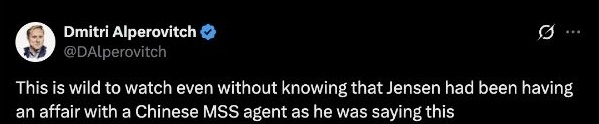
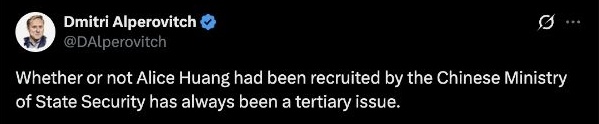
Claim two: “Singapore investigated her”
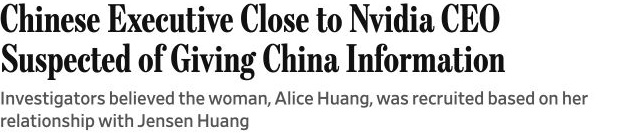
The Journal’s question to Singapore’s embassy, which Singapore published: “The Wall Street Journal has learned that Singapore’s intelligence agency has suspected Alice Huang (also known as Huang Le), who has been associated with the Singapore-based data center company Megaspeed, of being an asset of China’s Ministry of State Security.”
Singapore’s Ministry of Home Affairs, the next day: “We would like to make clear that neither the Singapore Government nor its officials said this. And there were no such investigations conducted in respect of Alice Huang” (MHA, 31 October). And on 12 November: “Huang was not based in Singapore, and was not investigated for espionage.” Its own case was a domestic one, opened in February 2025 by the police and Customs over “potential false declarations in relation to the purchase of servers,” and “not based on any request from any country or sovereign entity” (MHA, 12 November).
The Journal ran the Singapore line again on 9 November, in “The Chinese Woman at the Center of a Spy Probe After an Affair With Jensen Huang” (Stu Woo and Raffaele Huang) (The Wall Street Journal). Effort’s verdict on this claim: “the Wall Street Journal has been caught fabricating quotes from the Singaporean government.”
Claim three: “a national-security nightmare”
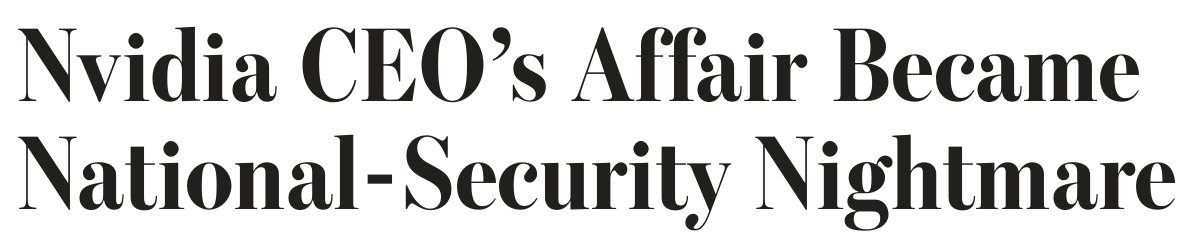
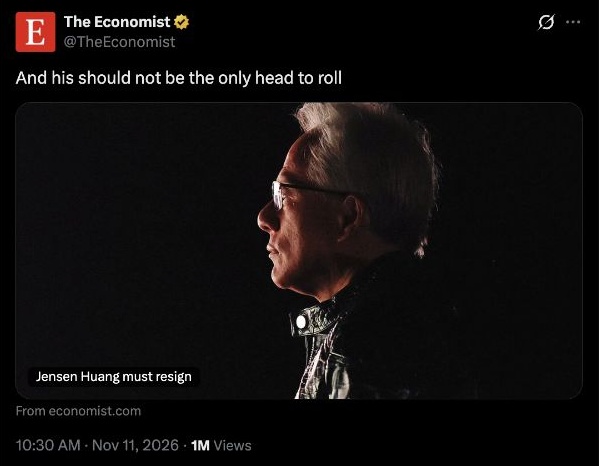
The same week: “Jensen Huang Affair Revives Push for Chip Restrictions on Capitol Hill” (Ramkumar, 10 November) (The Wall Street Journal); “Nvidia Is Preparing to Oust CEO Jensen Huang” (Whelan, Josh Dawsey, Ramkumar, 11 November) (The Wall Street Journal); the Times’s second-relationship story (Ryan Mac, Mickle, Georgia Gee, 11 November) (The New York Times); the Journal’s editorial board, “Of Course Jensen Huang Had to Go” (13 November) (The Wall Street Journal); and “How Jensen Huang Built the Backdoor Route That Keeps Beijing in the AI Race” (Jon Emont, Woo, Patricia Kowsmann, Raffaele Huang, 14 November) (The Wall Street Journal).
The record from the two departments that run the export case:
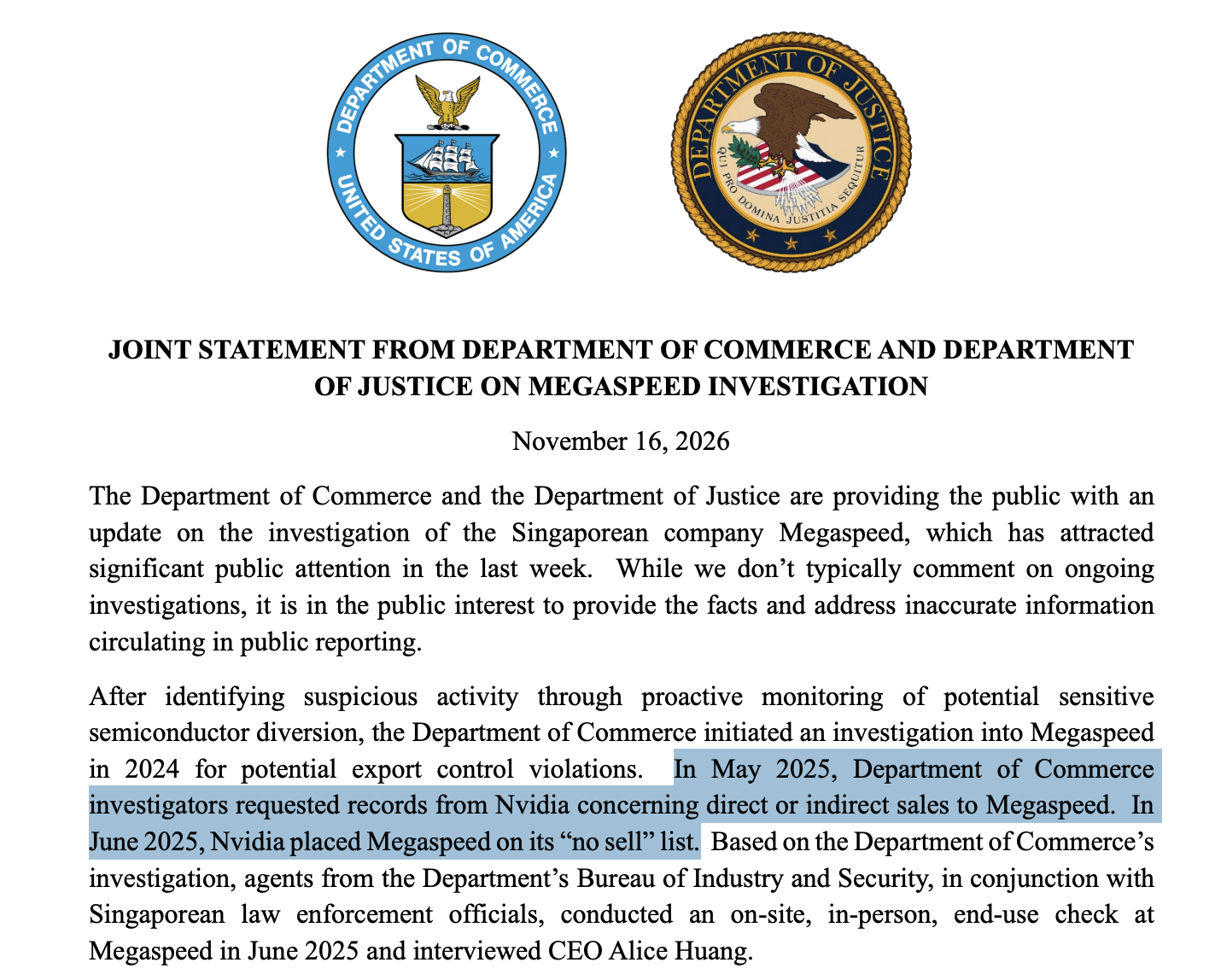
In the departments’ words, they spoke “to provide the facts and address inaccurate information circulating in public reporting”: “In May 2025, Department of Commerce investigators requested records from Nvidia concerning direct or indirect sales to Megaspeed. In June 2025, Nvidia placed Megaspeed on its “no sell” list.” The criminal case is against Megaspeed (joint statement). Effort heads the statement “Jensen fully compliant with export controls”; Chau reads it as NVIDIA “fully and immediately compliant with both their regulations and informal requests regarding Megaspeed.” The statement itself names no violation by NVIDIA and grants it no clearance; it gives the two dates. The President, the same day, as Effort quotes him: “It was not put at risk, and our country is now stronger than ever before.”
Claim four, and the case beneath it
Chau’s fourth claim is the export one: “Nvidia illegally circumvented export controls in business dealings with Megaspeed (definitively debunked November 16th).” Both ledgers then make the same structural point. Effort: “In 2023, 2024, and 2025, policies to restrict third party datacenters were proposed in Congress. In all three cases, at least one chamber of Congress decided not to pass the bill. It was the explicit will of Congress that the benefits to third party datacenters exceeded the costs, not merely an unintended loophole.” And: “The Jensen coup is an overt weaponization of the government and the press to achieve policy outcomes which failed to pass through Congress.” Chau, on the Journal’s account that the campaign began over NVIDIA’s refusal to cut off third-country servers: “is that illegal? The answer — an emphatic no.”
Whom the ledgers hold responsible
Chau names the six bylines on the Times’s first story and asks that they answer for it: “The actual perpetrators of the Nvidia coup — Jonathan Swan, Maggie Haberman, Ana Swanson, Paul Mozur, Tripp Mickle, Julian E. Barnes.” He sets out two cases for the paper’s sourcing, “There was a rogue leaker who deceived NYT into mischaracterizing the entire Intelligence Community,” or “There was no leaker, and NYT knowingly misattributed the claims to the Intelligence Community,” and says the Times “has not even issued corrections on stories they now admit they “have not reported evidence” for.” He quotes Vanity Fair’s Julia Black after the reinstatement: “my heart goes out to the intrepid team at the @nytimes who did absolutely generational reporting on the Nvidia scandal.” He puts the cost at “2.3 trillion dollars before it was reversed” and links a retraction-request form (X, @brianchau57).
The full byline ledger, from Effort’s timeline: The New York Times (Jonathan Swan, Maggie Haberman, Ana Swanson, Paul Mozur, Tripp Mickle, Julian E. Barnes, Ryan Mac, Georgia Gee); The Wall Street Journal (Robbie Whelan, Amrith Ramkumar, Joseph De Avila, Lingling Wei, Stu Woo, Raffaele Huang, Josh Dawsey, Jon Emont, Patricia Kowsmann, and the editorial board); the Financial Times (Demetri Sevastopulo); The Washington Post (Ian Duncan, Zach Dorfman, Warren P. Strobel, whose 13 November piece reported that “Rubio’s intervention helped topple” Huang) (The Washington Post); The Economist (its leader); the BBC (Michael Race and Osmond Chia, “suspected Chinese spy,” 17 November) (BBC News). The sources inside government who briefed them are named by no one.
The argument on X, after the reinstatement
The fight over what the coverage was for ran on X on 23 November, the day the board put Huang back. It started with a Vanity Fair writer’s post about the Times team, seen nearly eight million times:
my heart goes out to the intrepid team at the @nytimes who did absolutely generational reporting on the Nvidia scandal
I know the feeling of trying to do accountability journalism in a culture that simply does not care about accountability. Incredibly disheartening.
Jason Calacanis quoted it five hours later, and drew some 400 replies:
It is not the job of journalists to hold people accountable; it’s to collect, verify and report facts to the public so they can make more informed decisions in their lives.
The parody came within the hour:
my heart goes out to the people whose pensions and retirement accounts were put at risk by the Nvidia smear campaign
I know the feeling of trying to build generational wealth while someone else is trying to win a Pulitzer. Incredibly disheartening.
The @nytimes did bad faith journalism on Jensen. You could tell they were fishing for scandals just to try to cancel him. They wanted to feel the power of destroying the American economy and one of the most beloved CEOs, just because they thought they can. Shameful behavior.
They say Jensen would be happier with a pile of cash than running the company he has bled, sweat, and fought for his entire life.
Zero theory of mind or any understanding whatsoever of what motivates people.
Under Calacanis’s post the replies split the same way the coverage did. For the press: “It is literally the job of journalists to hold people in power accountable by reporting and verifying facts to the public” (@LamplighterUS); “Top tip: It is literally the job of journalists to hold people accountable” (@davidrvetter); “The mere existence of an estate, let’s say the fourth estate, meant to operate as another layer of accountability” (@EvelynRusli). Against it: “The only people journalists should be holding accountable are journalists. The one group they absolutely refuse to” (@JHartley2); “Printing the copy provided to you by a government leaker is not journalism” (@pontiusP33). The common reading, in one reply among many like it:
@Jason Also let’s not fool ourselves @nytimes wasn’t working to hold anyone accountable, they are an arm of the Democrat Party and want to get rid of @JensenHuang because he believes in an AI beneficial to the people not controlled by bureaucrats in DC.
Democrat Party want to control AI so they can control the people.
A reply under it put the motive elsewhere: “in this particular case, an arm of the EA movement who are cult worshippers of Anthropic” (@Ngc4889X, 25 November). Section 4 sets out what the record shows about who funds the writers who called for the ouster.
After the briefing to congressional staff (above), the argument turned from the coverage to the leak. A commentator’s summary of the reporting:
🚨 JUST IN: U.S. intelligence officials have told Congress there is NO EVIDENCE China directed Alice Huang to start an affair with Nvidia CEO Jensen Huang, per WSJ and NYT
The FBI, CIA and ODNI briefed House and Senate Intelligence staffers in a classified session, one day after President Trump helped get Huang REINSTATED as Nvidia CEO
Trump said Huang posed no national security threat, and AG Todd Blanche says there’s NO evidence of wrongdoing by Huang
Huang will be questioned privately by committees next Tuesday and testifies publicly before Senate Banking on December 3
As more comes out, it seems Trump has solidified his confidence in Huang!
47 even said while he was in China that the spy allegation was unproven:
And the charge it set up, quoting it:
The New York Times nearly sunk an American company. They called her a Chinese spy. She wasn’t. This was a crime. The leak itself was a felony violation of the espionage act. The episode was at the same level as the worst things they accused Jensen of. Hundreds participated.
Calacanis came back to the sourcing two days later:
@thejefflutz The @NYTimesPR will have their anonymous sources process for this series well documented, and they will very easily be able to navigate any investigation or hearing.
They wouldn’t run a series like this if they didn’t have solid sources, however, those sources will have an agenda I’m 99% certain.
Either they’re china hawks who wanted to win the President’s ear, or they are anti-Trump forces looking for a way to damage the current administration.
Small chance they are sources in the frontier model space, looking to ban open source in a China mania
10. The walled reporting, with mirrors
The pieces that drove the story sit behind paywalls. Each is linked at its source, with a mirror beside it. The New York Times page of 29 October names its byline as “By Jonathan Swan, Maggie Haberman, Ana Swanson, Paul Mozur, Tripp Mickle and Julian E. Barnes” (The New York Times, 29 Oct 2026).
| Date | Outlet and headline | Source | Mirror |
|---|---|---|---|
| 29 Oct 2026 | The New York Times, “Nvidia Chief Seen as Target of Chinese Spy Plot” | nytimes.com | mirror |
| 6 Nov 2026 | The New York Times, on China’s spy agency and the woman who targeted Huang | nytimes.com | mirror |
| 7 Nov 2026 | Financial Times, on the US belief that Huang had a relationship with an alleged spy | ft.com | mirror |
| 8 Nov 2026 | The New York Times, on Rubio’s warning | nytimes.com | mirror |
| 9 Nov 2026 | The New York Times, on the Commerce inquiry into Megaspeed | nytimes.com | mirror |
| 11 Nov 2026 | The New York Times, on the relationship with an executive who reported to Huang | nytimes.com | mirror |
| 11 Nov 2026 | The Wall Street Journal, on the ouster | wsj.com | mirror |
| 11 Nov 2026 | Axios, on Lutnick and the chip curbs | axios.com | mirror |
| 12 Nov 2026 | The New York Times, on Trump urging Huang to fight for his job | nytimes.com | mirror |
| 12 Nov 2026 | Associated Press, on the resignation | apnews.com | mirror |
| 12 Nov 2026 | The Washington Post, on the fake accounts defending Huang | washingtonpost.com | mirror |
| 13 Nov 2026 | The Washington Post, on the shadow war for Trump’s ear on China | washingtonpost.com | mirror |
| 14 Nov 2026 | The New York Times, on the secret Huang carried for more than a year | nytimes.com | mirror |
| 23 Nov 2026 | The New York Times, on how Trump got Huang reinstated | nytimes.com | mirror |
| 23 Nov 2026 | The Wall Street Journal, on the White House push to get Huang back | wsj.com | mirror |
| 23 Nov 2026 | Politico, on JD Vance’s role in the return | politico.com | mirror |
| 23 Nov 2026 | Reuters, on Trump seeing Huang as protector of open-weight models | reuters.com | mirror |
| 23 Nov 2026 | Bloomberg, on the reinstatement made without consulting management | bloomberg.com | mirror |
| 16 Nov 2026 | Politico, on Bessent pushing the new chips rule | politico.com | mirror |
The bodies quoted on this page were read from the mirror snapshot linked beside each quotation, and Politico’s two pieces from the live pages. The Financial Times of 7 November, the Times of 23 November, Bloomberg and Reuters return a login wall at the source and at the mirror, and are cited here for their headlines only.
The Financial Times’s own headline, from the mirror: “US believes Nvidia’s Huang had romantic relationship with alleged Chinese spy” (Financial Times, 7 Nov 2026 (mirror)).
Sources: NVIDIA, Form 8-K, 11 Nov 2026; NVIDIA, Form 8-K, 22 Nov 2026; NVIDIA, DEF 14A, 2026; NVIDIA, Form 8-K, 24 Jun 2026; NVIDIA Newsroom, reinstatement; Federal Register, 2026-23529; Tarbell, about; Tarbell, grants; Tarbell, institutional grants; Tarbell, fellowship; Transformer, about; Transformer, Hashim; Platformer; Platformer, ethics; Platformer, 24 Nov; The Verge, Hart; The Verge, Roth; The Guardian, Down and Milmo; The Guardian, 23 Nov; The Dispatch, Kubinec; USA Today, Reich; Semafor, 17 Nov; Semafor, 23 Nov; CNN, 12 Nov; CNN, 13 Nov; CBS News, 22 Nov; CBS News, 23 Nov; WIRED; Vox; SemiAnalysis; Model Republic; Midas Project, Urban Legend; Midas Project, donate; Washington Examiner; The Dispatch, Catoggio; Anthropic, open weights; NVIDIA, open-weights letter (PDF); NYU Shanghai RITS; Asana, DEF 14A
Keep reading
- researchThe Nvidia Coup: The Foreign HandsEvery foreign state and every foreign fortune the record shows in the Nvidia affair, on both sides: the channel each used, the American institutions it reached, and where each stands.
- dispatchesThe Yoink of NVIDIATwo words removed the founder of the most valuable chip company on earth. No agency would sign them. A phone call from the President put him back, and the White House said out loud what the fight had been about: open models.
- researchThe Nvidia Coup — Who Drove It, Who Stood to Gain, Why Trump Stopped ItThe people who pushed Jensen Huang out of Nvidia in November 2026, the people positioned to profit from his absence, and the reasons the President and his allies put him back, each from the record.
- profilesTARBELL CENTER FOR AI JOURNALISMAlso names Aisha Down.
- Named here
- A. Brooke Seawell, Aarti Shah, Alberto Martinez, Amaryllis Fox Kennedy, AMD, Amjad Masad, Anthropic, Anthropic PBC Political Action committee, Ballard Partners, Bill Huizenga, BlackRock, Bureau of Industry and security
and 80 more
Center for Ai Safety, Chris Coons, Chris McGuire, Colette Kress, Continental Strategy, Dario Amodei, David Sacks, Dawn Hudson, Don Bacon, Dustin Moskovitz, Elizabeth Warren, Elon Musk, Founders Pledge, Future of Life Institute, GIC, Google DeepMind, GovAI, Harvey C. Jones, Howard Lutnick, Hugging Face, Innovation Council Action, Intel, Jack Clark, Jay Clayton, JD Vance, Jeffrey Kessler, Jensen Huang, Jim Banks, Jim Himes, John Cornyn, John Curtis, John O. Dabiri, Koios / IntellACT, Marco Rubio, Mark A. Stevens, Megaspeed, Melissa B. Lora, Meta, MGX, Micah Ketchel, Microsoft, Nvidia, Open Philanthropy, OpenAI, Oracle, Palmer Luckey, Pete Ricketts, Peter Mattis, Rene Haas, Robert Garcia, Ron Wyden, Ruben Gallego, Sam Altman, Scott Bessent, SecureBio, SemiAnalysis, Sequoia Capital, Shakeel Hashim, Stand with Jensen, Stephen C. Neal, Steve Bannon, Survival and Flourishing Fund, Susie Wiles, Suzanne Nora Johnson, Tahnoon bin Zayed Al Nahyan, Tarbell Center for AI Journalism, Temasek, Tench Coxe, The Midas Project, The Oversight Board, Tim Scott, Tim Sweeney, Tim Teter, Todd Blanche, Tom Cotton, Transformer, TSMC, Tyler Johnston, Urban Legend, Vanguard - In the books
- The Ratchet, Quiet Autocomplete